Giselle, a distinctly Romantic ballet
December 16, 2025
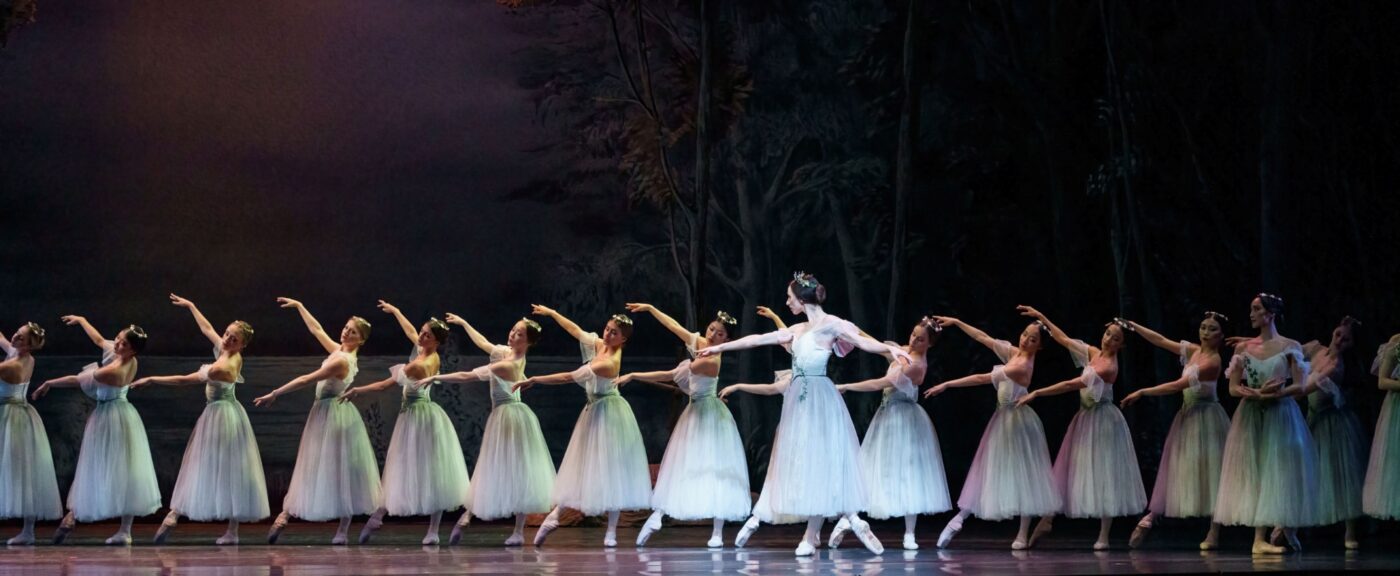
Giselle, originally choreographed in 1841, is one of the great Romantic ballets, but not just for its harrowing love story at the center of its plot. Created during the peak of the artistic, literary, and cultural Romantic era, themes of hysteria, death, class, love, and risk drive the eponymous lead in this two-act ballet.
Set in an idyllic medieval village, Act I follows Giselle as she is deceived by the nobleman Albrecht, secretly betrothed to another. After discovering Albrecht’s betrayal, Giselle dies of a broken heart. In Act II, the “white act,” she joins the corps de ballet of Wilis—spirits of maidens jilted and dead before their wedding day, condemned to rise nightly to dance men to their deaths. Through the contrasts of Act I and II, including innocence and betrayal, life and death, and the earthly and ethereal, Giselle exemplifies the core of the Romantic tradition.
As a counterculture responding to the Industrial Revolution and the Enlightenment, Romantics rejected rapid urbanization and revered the sublime—the mixture of awe, beauty, and terror inspired by vast, uncontrollable forces like the environment or death. They celebrated unrestrained self-expression and individualism in opposition to rationalism, with the incomprehensible nature of human instinct and the natural world as conduits to the divine. These ideals were often manifested through the supernatural, with Gothic and pastoral themes emphasizing humanity’s fragile, mysterious place within the world.
Such themes appear in other Romantic works like Frankenstein, Jane Eyre, and Beethoven’s Pastoral Symphony, where awe, unpredictability, and nature drive an emotional experience. In ballet, Gothic supernatural female characters such as sylphs, Wilis, and ghosts dominated storylines, captivating audiences and embodying ideals of beauty, mystery, and otherworldliness. These pivotal roles elevated and showcased female dancers, establishing the ballerina as the central artistic figure as we know her today.
A hallmark of the era, the “white act,” or “ballet blanc,” typically a second-act scene, utilized the full force of the corps de ballet dressed in white to portray these apparitional beings. Seen in Giselle, La Bayadère, Les Sylphides, among others, the “white act” opposed the traditional divertissement style of Classical ballet. Instead of a series of short, small-group dances designed for entertainment and variety, the “white act” served as an introspective and character-driven counterpoint to more dramatic narrative acts.
While Romanticism shaped the choreography, costuming, and narrative of ballet, new technologies expanded the possibilities of production. Tulle allowed for long, bell-shaped white skirts that grazed the ankles, enabling freer movement, and was later named after the era. Pointe shoes, first used for aesthetic effect in Les Sylphides eight years before Giselle, allowed ballerinas to appear to levitate as ghostly apparitions, a technique Giselle later embodies as a mythical Wili. All of this was additionally enhanced by the soft, mysterious glow of new gas lighting.
In both function and form, Acts I and II of Giselle set it apart as a distinctly Romantic ballet. Its atmosphere, symbolism, and engagement with nature, instinct, and the supernatural tie it closely to the movement’s larger ideas. The work serves as both an exemplar of Romantic ideals and an invitation to sit with the beauty, tension, and unanswered questions that define the era.
Tickets to Giselle are on sale now. On stage at the Cobb Energy Performing Arts Centre from February13-15, 2026, a distinctly Romantic weekend.
Program notes written by Margaux Nicolas.