Significant Others: Sonia Delaunay's Color, Light, and Movement
August 25, 2026
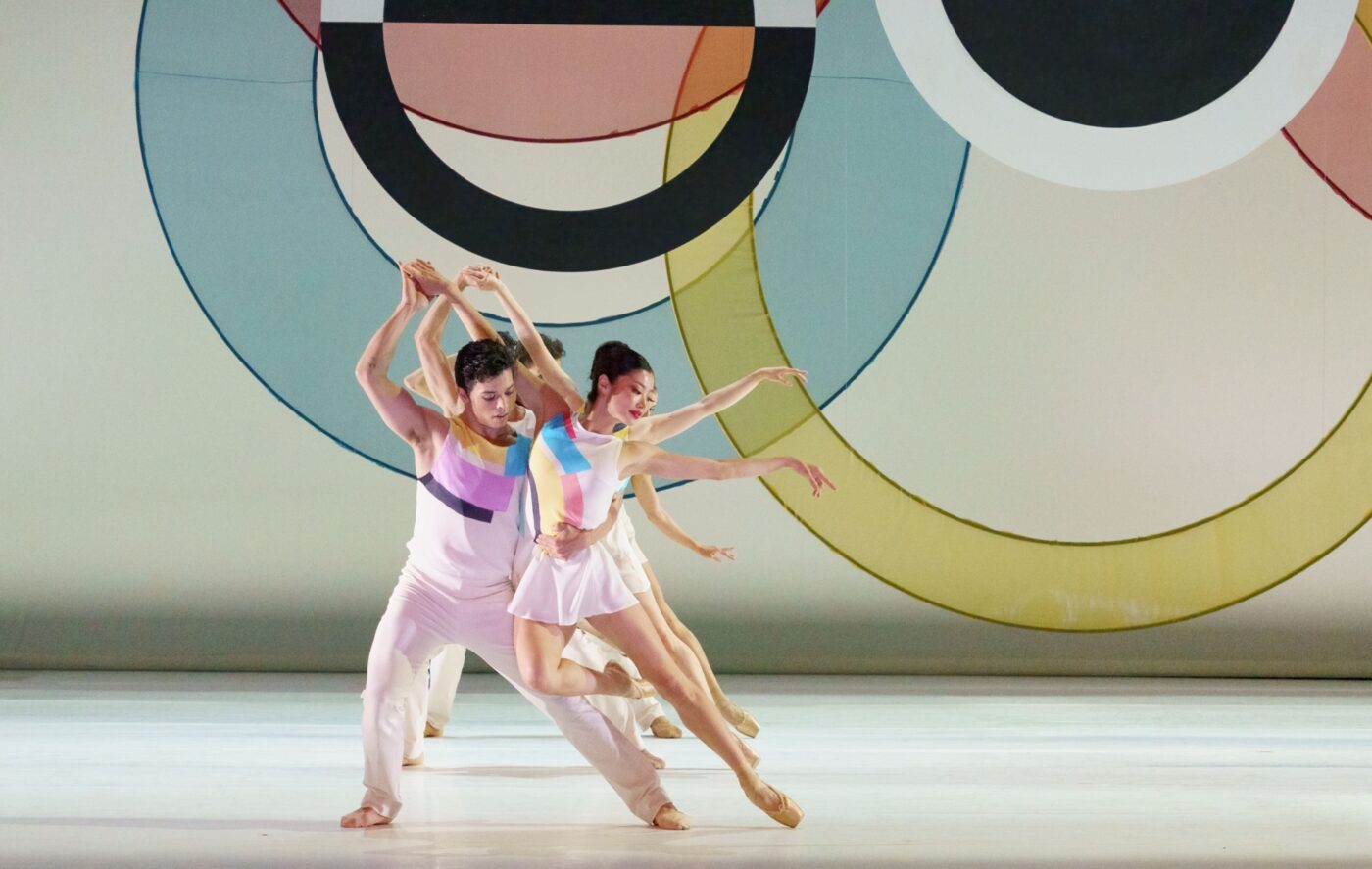
The set design in Remi Wörtmeyer’s Significant Others makes a striking impression. Enormous flat circles in primary and secondary colors rise, fall, and overlap, creating moving, abstract configurations of layered contrasting hues. These vibrant circular forms are echoed in the costumes, each featuring a unique, hand-painted composition. The set and costumes, together with choreography set to the music of Fanny Mendelssohn, create a total work of art – a moving painting and living sculpture – that makes audiences feel as though they are inside a Sonia Delaunay painting.
Modern artist Sonia Delaunay, one of the inspirations for Wörtmeyer’s ballet, may be well-known as the “significant other” of her painter husband Robert Delaunay, but the significance and impact of her work expands far beyond her associations with her spouse.
Who was Sonia Delaunay?

Born in 1885 in Ukraine (the Russian Empire at the time) as Sarah Elievna Stern, Sonia Delaunay spent her early years in the village of Gradizhsk. At the age of seven, she went to live with relatives in St. Petersburg where she received a well-rounded education. With the support of her uncle, she studied art in Germany as a teenager, before finally settling in Paris.
Paris in the early twentieth century was a gathering space for the avant garde – forward-thinking artists, writers, and composers – including well-known names like Pablo Picasso and Georges Braque. Avant-garde artists were radically redefining artistic practice, exploring new possibilities in visual art through a diverse range of styles and movements. It is within this artistic milieu that Sonia Delaunay created. Sonia held her first solo exhibition in 1908, showing paintings inspired by modern fauvist and expressionist styles. In 1910, she married her “significant other,” painter Robert Delaunay. Together, they developed new ideas about the interactions between color, light, and form.
Color and Light

While Sonia’s early paintings experimented with figuration, she ultimately turned to abstraction with a particular focus on color. In fact, her first abstract work was a colorful patchwork blanket of rectangular and triangular pieces that Sonia made for her newborn son Charles in 1911. Among her first large-scale works is the nearly twelve-foot-wide painting Bal Bullier (1913), which depicts a modern Parisian dance hall illuminated by bright lights. The composition’s vibrancy and movement come not from naturalistic details, but from the interplay of color and form. The juxtaposition of bright contrasting colors (like blue and orange) in geometric shapes radiate energy and light and create rhythm across the composition. Through the language of abstraction, Sonia’s dance hall conveys the excitement and vibrancy of modern Parisian nightlife.

Sonia’s and Robert’s painting style, termed Orphism, is identifiable by bright colors in purely abstract compositions. The Delaunays developed what they called simultanéisme (Simultanism), a style focused on the “simultaneous contrast” of colors. Simultanism juxtaposed contrasting colors (for example, primary and secondary colors) to create visual vibrations that intensify the effect of each color, as in Sonia’s painting Electric Prisms (1914). Electric Prisms is an explosion of color capturing the effects of the new electric lights illuminating Paris. Sonia’s use of flat colors, curves, and concentric circles combine to evoke feelings related to modern life (and are motifs that recur in her artwork).
Creative Collaborations

Sonia applied the ideas of simultaneous contrast used in painting to textile design, fashion, costume design, and interior decorating. Her multidisciplinary pursuits blurred the distinctions between art and life and elevated artistic media that had traditionally been marginalized (such as fashion and home furnishing). In 1913, in her first foray into fashion, she created a “simultaneous dress” collaging different oddly shaped pieces of fabric in a range of primary and secondary colors. Wearing the colors and forms of her painted works was only the first merging of art and life. In 1918, while living in Madrid during the interwar years, Sonia opened Casa Sonia a lifestyle boutique featuring garments, textiles, and home furnishings. In 1924, back in Paris, she opened a fashion studio, Maison Sonia and by 1925 (after the successful exhibition of her fabrics at the International Exhibition of Modern Decorative and Industrial Arts in Paris) she had her own fabric shop, Atelier Simultané. Her wide range of garments and accessories in bold abstract patterns appealed to the 1920s fashion preferences for loose, minimally tailored garments and eventually could be acquired in department stores in Europe and the United States.

Sonia’s successes drew the attention of theater companies, leading to commissions for costume designs. She designed costumes for Sergei Diaghilev’s Ballets Russes, including the 1918 revival of Cléopâtre (Cleopatra) as well as for the Liceo Theatre’s (Barcelona) production of Aida (1918), and Tristan Tzara’s Dada production Coeur à gaz (1923).
Her collaborations were numerous, working with manufacturers, poets, filmmakers, and designers. She designed posters, book bindings, housewares, furniture, window displays, and books (including a six-foot long “simultanist” book). She even applied her designs to cars, including her friend Maurice Kaplan’s Ariès 5-8hp Torpedo boat-tail convertible!

In the 1950s she began to exhibit her work again at numerous international galleries. Remarkably, in 1964, the Louvre mounted a retrospective of Sonia’s work – a first for a living female artist – featuring 117 works she selected and donated. Sonia died at home in Paris on December 5, 1979 at the age of 94.

The reverberations of Sonia Delaunay’s art and artistic styles can be felt in later styles, such as the Op art of the 1960s and in Remi Wörtmeyer’s Significant Others. Wörtmeyer’s multi-media artistic work – he designed the sets and costumes in addition to choreographing the ballet – is a testament to Sonia’s legacy as a multidisciplinary creator. As in Sonia Delaunay's works, Significant Others merges art and life, using contrasting colors to create a sense of dynamic movement and emotion. It evokes, in her own words, “a language much more expressive than the old methods… in tune with the vibrations, the life itself, of color. In this there are new and infinite possibilities” (1949).
Celebrate the relationships, emotions, and stories that connect us in Passion & Pride, Atlanta Ballet’s 2026|27 season opener. The program features Remi Wörtmeyer’s Significant Others; Plagued Houses, a world premiere by Melissa Hough; and George Balanchine’s Stars and Stripes. Experience these compelling works onstage at the Cobb Energy Performing Arts Centre, September 18–20, 2026. Tickets are on sale now.